
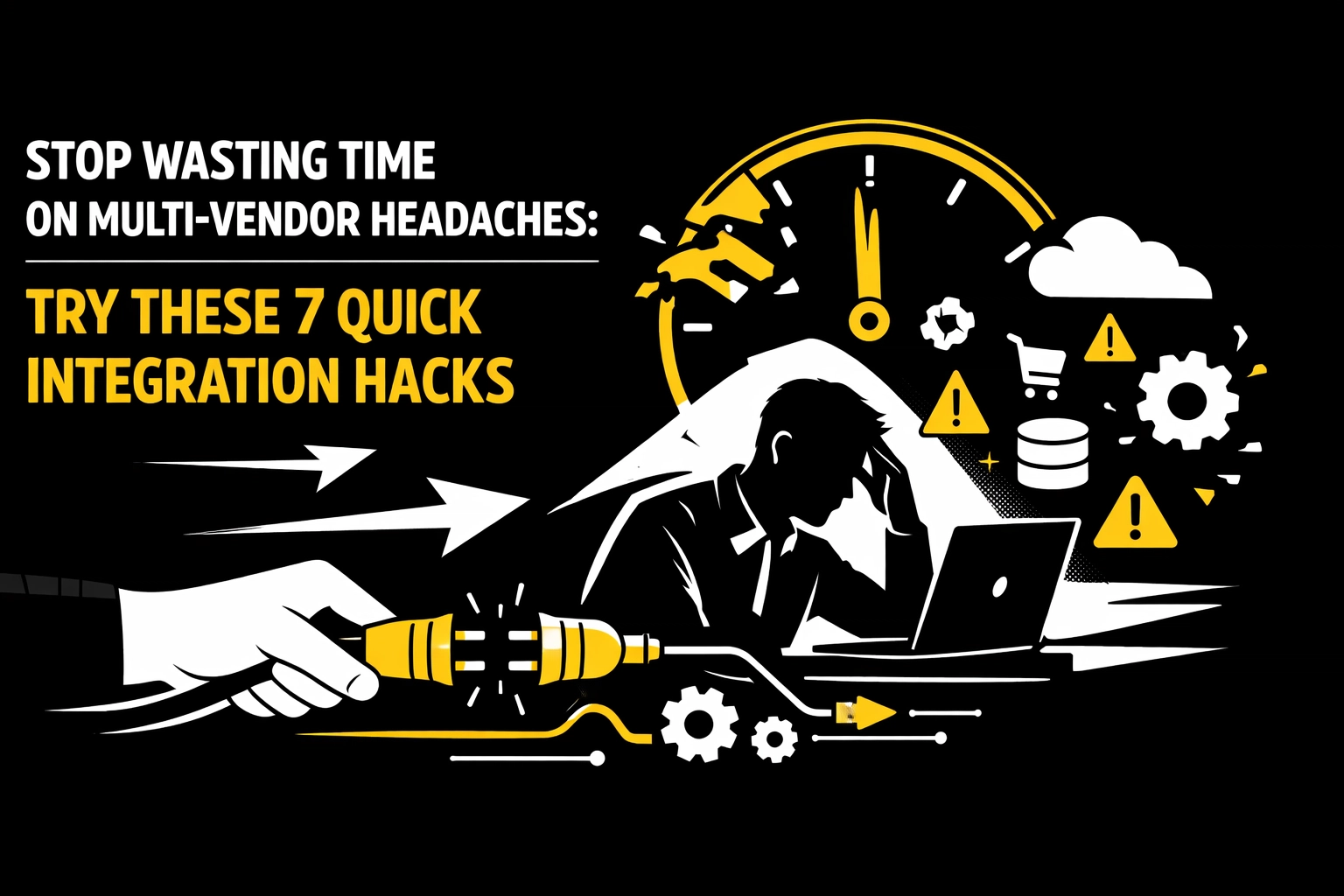


Let's be honest, juggling multiple vendors feels like herding cats. Your POS talks to one system, your inventory software speaks a different language, and your accounting platform? Well, it's off doing its own thing entirely. Meanwhile, you're stuck playing telephone between systems that refuse to shake hands.
Sound familiar? You're not alone. Studies show that 76% of businesses face costly data integration challenges when working with multiple vendors. But here's the good news: you don't need a computer science degree to tame this chaos. Let's dive into seven practical integration hacks that'll save you time, money, and a whole lot of frustration.
Think of middleware as the universal translator for your tech stack. When your legacy dispatch system needs to chat with your shiny new project management tool, middleware steps in to convert data formats and enable real-time communication.
The beauty? You don't have to rebuild everything from scratch. Middleware tools bridge the gaps between systems that weren't built to work together, saving you from expensive custom development. It's like having a bilingual friend who can translate conversations on the fly: suddenly, everyone understands each other.

Stop toggling between seventeen browser tabs to check order status, inventory levels, and vendor performance. A central dashboard gives you a bird's-eye view of your entire operation in one place.
When you can see orders, catalogs, and vendor status at a glance, you make faster decisions. No more digging through emails to figure out why an order's delayed or which vendor has stock. Everything you need lives in one command center, and your morning coffee suddenly tastes a lot better.
Here's where things get interesting. Forget those clunky API calls that check inventory every few hours. Webhooks push updates the instant something changes: like a friend texting you immediately instead of waiting for you to call them.
This real-time sync prevents those nightmare scenarios where you sell something online that's already out of stock in your warehouse. No more overselling, no more angry customers, and no more awkward apology emails. Just clean, accurate inventory data flowing seamlessly between systems.
When was the last time you charted how all your tools and services connect? If you're drawing a blank, you're not alone: but you're also playing with fire.
Dependency mapping shows you which systems talk to each other and what breaks when one goes down. It's like having a wiring diagram for your business. When something inevitably hiccups (because, let's face it, it always does), you'll know exactly which vendors to contact and what's affected. No more panic-induced guesswork.

Nobody enjoys ripping out their entire tech stack overnight. It's expensive, risky, and guaranteed to give you at least three new gray hairs.
Instead, identify the components causing the biggest integration headaches and tackle those first. Maybe it's your ancient payment processor that doesn't play nice with modern systems, or that inventory tool that requires manual exports. Fix the worst offenders, then gradually modernize the rest of your stack. Your sanity (and your team) will thank you.
Here's a game-changer: designate one person as the primary owner for each major business function: even when multiple vendors are involved.
This isn't about micromanaging. It's about having someone who coordinates vendors, knows who to call when things break, and can resolve issues without playing endless rounds of vendor ping-pong. When your payment processing goes down at 2 PM on a Saturday, you'll have one person who knows exactly what to do instead of a group chat full of finger-pointing.
This one sounds boring, but stick with me: it's pure gold. Auditing, standardizing, and mapping your workflows before you integrate anything saves you from expensive do-overs later.
Take time to document how data should flow between systems, what format it needs to be in, and who's responsible for what. When everyone's following the same playbook, integrations go smoother, onboarding is faster, and troubleshooting becomes way less painful.

Now, here's where things get really interesting. What if you could reduce your vendor headcount while actually increasing functionality? That's the Odoo advantage.
Odoo is an all-in-one business management platform that handles everything from inventory and sales to accounting and CRM: all speaking the same language by default. No middleware. No dependency mapping nightmares. Just clean, native integration between modules.
The best part? One Odoo app is free forever. Want to try multiple apps? You get a 15-day trial (and BK Touch can extend that to 30 days for hands-on learning). It's the perfect way to test whether consolidating your tech stack makes sense for your business.
And speaking of integration-friendly technology: BK Touch hardware is specifically designed to work seamlessly with Odoo and other modern platforms. Our self-checkout kiosks and point-of-sale systems integrate smoothly with your existing tech stack, eliminating another potential headache from your vendor roster.
Ready to stop juggling vendors and start actually running your business? Here's what to do next:
This week:
This month:
This quarter:
Multi-vendor integration doesn't have to be a constant headache. With the right strategies: and the right technology partners: you can create a tech ecosystem that actually supports your business instead of holding it hostage.
Whether you implement all seven hacks or start with just one or two, you'll immediately feel the difference. Less time troubleshooting integrations means more time growing your business, serving customers, and maybe even leaving the office before midnight.
Ready to explore how BK Touch can simplify your retail technology stack? Visit our website or check out our blog for more integration insights. Your future, integration-headache-free self will thank you.
Bolder > Boundless > Better > Integration.


